
Showing posts with label prednisone. Show all posts
Showing posts with label prednisone. Show all posts
Sunday, November 27, 2011
One Year Anniversary!!
Tomorrow will be Coby's one year anniversary of being prednisone FREE!! YAY!! On this day, one year ago, Coby received his last dose of prednisone. It was a scary time, I was very nervous & anxious. I wasn't sure what to expect. Of course my greatest fear was Coby relapsing. I watched over him like a hawk for days, weeks, even months. Now, that one year has passed, my anxiety & fear has decreased. I am still very watchful of him & his behavior - ready to pick up on any little change of personality. However, I don't worry excessively about him when I'm away and he's home alone. Coby is a fighter. He remains healthy & happy in remission & doing great! Coby has beat GME & continues to be a story of HOPE for all those others pups out there fighting this disease. Don't give up, don't believe the horror stories out there, stay strong, stay positive & contact the right doctor to help you beat GME!


Thursday, September 22, 2011
Tomorrow Coby hits day 300!!!
Tomorrow will mark day 300 of being prednisone free!!! 300!!! Way to go to my little man...what a trooper he's been this past year. HOWEVER....Coby did decide to give us a scare the first day we moved into our new apartment in Florida. Not sure if he slipped or jumped, but he "fell" 2 stories from the balcony/roof. He had diarrhea...the first day in our new place, so I pushed him onto the balcony, thinking he wouldn't try & escape. Well...I turned my head for a couple minutes to clean up what he started in the house & he disappeared. I ran all over the "roof" of the building & couldn't find him - he squeezed his skinny butt thru our balcony railings (see photos below). Anyways, I just happened to look down to see if he "jumped" & sure enough....he was down on the drive way area, near a busy street, just sitting there. He was obviously hurt b/c he tried to walk & was limping. He wasn't crying, but he was hurt. I almost jumped off the roof myself to get him, but thankfully someone drove by & stopped to make sure Coby stayed put until Chris got downstairs. So...I then took "superman" to the ER for x-rays & they didn't see anythikng broken or wrong. However, Coby was still walking goofy & not normal, so the vet suggested seeing an orthopedic specialist about 30 minutes north of where we were - so I rushed Coby there thru rush hour traffic. They only said it looked like Coby has/had a luxating patella in his left leg - which I'm almost positive is the side he "fell" on & that is new. So, he was just put on some anti-inflammatory & pain meds for a week....along with "bed rest". LOL He's doing better now, but what a scare. And $700 later.....our first day in our new apartment....OMG! Coby the flying wonder dog!!!


Tuesday, November 30, 2010
Treatment of Autoimmune Diseases of the Central Nervous System of Dogs
I recently found an interesting article while researching GME. I wanted to add more GME information to the blog & I stumbled upon a website, which linked me to a newsletter - it was the Veterinary Referral News from Angell Animal Medical Center. This is the animal medical center in Boston where our neurologist works. He even wrote an article for this Summer 2010 edition of the newsletter. I've copied & pasted the entire article, but also included the link to the website.
Veterinary Referral News from Angell Animal Medical Center
http://www.mspca.org/assets/documents/alumni_news_september-2010.pdf
Treatment of Autoimmune Diseases of the Central Nervous System of Dogs
By Allen Sisson, DVM, MS, DACVIM (Neurology)
Several inflammatory, primary central nervous system (CNS) diseases of dogs have been described:
1. Granulomatous Meningoencephalomyelitis (GME)
2. Necrotizing Encephalitis of Pug, Maltese, and Yorkshire terrier dogs
3. Corticosteroid-Responsive or Neutrophilic Meningitis
4. Eosinophilic Meningoencephalomyelitis
5. Idiopathic Tremor Syndrome or Cerebellitis
It is now suspected that these idiopathic diseases are due to abnormal immune system function (an autoimmune disorder).
Depending on where in the CNS these diseases start, they can cause a wide variety of signs such as:
1. Progressively worsening central vestibular signs
2. Progressively worsening seizures and behavior abnormalities
3. Progressively worsening neck and/or back pain
4. Progressively worsening para- or tetraparesis often mimicking a disc herniation
5. Progressively worsening generalized severe-intention tremor
6. Acute onset of blindness
These signs can progress at various rates, but they are often acute (1–2 days) to peracute (8–12 hours) in duration. In the peracute form these CNS diseases are emergencies. If rapid neurologic deterioration is noted, immediate referral to a 24-hour emergency center or aggressive immunosuppressive therapy should be started until a spinal fluid analysis and advanced CNS imaging can be done to confirm the diagnosis. Since abnormal spinal fluid can be normalized within 24 hours of starting prednisone therapy, referral for diagnostic testing as soon as possible after initiating therapy is best. High-dose, low-term immunosuppression is the key to successful therapy for all autoimmune diseases of the CNS. For this reason it is important that infectious causes of CNS inflammation be ruled out by diagnostic testing, since immunosuppressive therapy would worsen these conditions. Corticosteroids, primarily prednisone, are the drugs of choice and are sometimes used as the sole therapy for neutrophilic meningitis. It is important that immunosuppressive doses be used initially, and therapy be sustained at high doses, very gradually tapered over many months, or relapses are likely to occur. Prednisone causes many adverse effects. When these adverse effects are severe, they may require the prednisone dose be reduced or even stopped and another immunosuppressive drug to be used in its place or combined with a reduced prednisone dose. In addition, when immune-mediated encephalitis or myelitis is present, it is unlikely that prednisone therapy alone can lead to permanent remission. For this reason the neurology service at Angell Animal Medical Center now treats all immune-mediated CNS diseases with combination immunosuppressive therapy. Dogs with immune-mediated meningitis are treated with prednisone and with the immunomodulatory drug leflunomide, which is a once-daily oral medication given for one year or in some cases longer. This drug inhibits T and B lymphocyte proliferation and function and is very effective. It is a bone-marrow suppressor and requires monthly CBC monitoring and initial dose adjustment based on leflunomide blood levels. Treated this way it is rare for immune-mediated meningitis cases to relapse, with most cases achieving permanent remission and coming off of all therapy within one year. Most dogs with GME are treated with a combination of prednisone, leflunomide and monthly cytarabine injectable therapy given over a 48-hour period. This three-drug combination leads to long-term remission in over 90% of dogs after one to 1.5 years of therapy. Pug dogs, Maltese and Yorkshire terriers that have necrotizing encephalitis, are given a combination of prednisone, leflunomide, cytarabine lomustine and cyclosporine modified. The cytarabine and lomustine are given monthly 14 days apart, since both drugs cause leukocyte nadirs 6 to 14 days post-treatment so that they cannot be given at the same time. The use of these two chemotherapy drugs in combination requires CBC monitoring twice a month, to be sure that neutrophil and platelet numbers are adequate before each therapy. Cyclosporine modified is given BID orally and requires dose adjustment based on blood level measurement. With this five-drug therapy for 1.5 years, about 80% of dogs with necrotizing encephalitis achieve complete remission.
For more information, please visit angell.org/neurology.
Veterinary Referral News from Angell Animal Medical Center
http://www.mspca.org/assets/documents/alumni_news_september-2010.pdf
Treatment of Autoimmune Diseases of the Central Nervous System of Dogs
By Allen Sisson, DVM, MS, DACVIM (Neurology)
Several inflammatory, primary central nervous system (CNS) diseases of dogs have been described:
1. Granulomatous Meningoencephalomyelitis (GME)
2. Necrotizing Encephalitis of Pug, Maltese, and Yorkshire terrier dogs
3. Corticosteroid-Responsive or Neutrophilic Meningitis
4. Eosinophilic Meningoencephalomyelitis
5. Idiopathic Tremor Syndrome or Cerebellitis
It is now suspected that these idiopathic diseases are due to abnormal immune system function (an autoimmune disorder).
Depending on where in the CNS these diseases start, they can cause a wide variety of signs such as:
1. Progressively worsening central vestibular signs
2. Progressively worsening seizures and behavior abnormalities
3. Progressively worsening neck and/or back pain
4. Progressively worsening para- or tetraparesis often mimicking a disc herniation
5. Progressively worsening generalized severe-intention tremor
6. Acute onset of blindness
These signs can progress at various rates, but they are often acute (1–2 days) to peracute (8–12 hours) in duration. In the peracute form these CNS diseases are emergencies. If rapid neurologic deterioration is noted, immediate referral to a 24-hour emergency center or aggressive immunosuppressive therapy should be started until a spinal fluid analysis and advanced CNS imaging can be done to confirm the diagnosis. Since abnormal spinal fluid can be normalized within 24 hours of starting prednisone therapy, referral for diagnostic testing as soon as possible after initiating therapy is best. High-dose, low-term immunosuppression is the key to successful therapy for all autoimmune diseases of the CNS. For this reason it is important that infectious causes of CNS inflammation be ruled out by diagnostic testing, since immunosuppressive therapy would worsen these conditions. Corticosteroids, primarily prednisone, are the drugs of choice and are sometimes used as the sole therapy for neutrophilic meningitis. It is important that immunosuppressive doses be used initially, and therapy be sustained at high doses, very gradually tapered over many months, or relapses are likely to occur. Prednisone causes many adverse effects. When these adverse effects are severe, they may require the prednisone dose be reduced or even stopped and another immunosuppressive drug to be used in its place or combined with a reduced prednisone dose. In addition, when immune-mediated encephalitis or myelitis is present, it is unlikely that prednisone therapy alone can lead to permanent remission. For this reason the neurology service at Angell Animal Medical Center now treats all immune-mediated CNS diseases with combination immunosuppressive therapy. Dogs with immune-mediated meningitis are treated with prednisone and with the immunomodulatory drug leflunomide, which is a once-daily oral medication given for one year or in some cases longer. This drug inhibits T and B lymphocyte proliferation and function and is very effective. It is a bone-marrow suppressor and requires monthly CBC monitoring and initial dose adjustment based on leflunomide blood levels. Treated this way it is rare for immune-mediated meningitis cases to relapse, with most cases achieving permanent remission and coming off of all therapy within one year. Most dogs with GME are treated with a combination of prednisone, leflunomide and monthly cytarabine injectable therapy given over a 48-hour period. This three-drug combination leads to long-term remission in over 90% of dogs after one to 1.5 years of therapy. Pug dogs, Maltese and Yorkshire terriers that have necrotizing encephalitis, are given a combination of prednisone, leflunomide, cytarabine lomustine and cyclosporine modified. The cytarabine and lomustine are given monthly 14 days apart, since both drugs cause leukocyte nadirs 6 to 14 days post-treatment so that they cannot be given at the same time. The use of these two chemotherapy drugs in combination requires CBC monitoring twice a month, to be sure that neutrophil and platelet numbers are adequate before each therapy. Cyclosporine modified is given BID orally and requires dose adjustment based on blood level measurement. With this five-drug therapy for 1.5 years, about 80% of dogs with necrotizing encephalitis achieve complete remission.
For more information, please visit angell.org/neurology.
Thursday, May 27, 2010
New Treatment Finally Begins
Good news...Coby's ready to start Dr. Sisson's new treatment protocol! YAY! We started his new anti-seizure medication Zonisamide tonight and began tapering him off the Phenobarbital. We will start the mega dose of Prednisone tomorrow morning. Take a look at my baby's medication schedule for the next 3 days!!
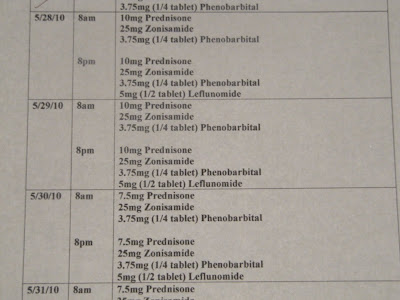
It took me at least an hour to put his entire medication schedule together. With all the medication changes - whether adding or discontinuing medication, decreasing or increasing medication doses, figuring out what blood work needs to be done when in conjunction with certain medication - it is overwhelming to say the least! But...I emailed my "medication schedule" to Dr. Sisson for his review - I had to make sure I had every med/dose/time correct. We're all set....however, it looks as if Coby will be on medication until at least mid-November.
Please continue to pray for Coby! Hopefully he responds VERY well to the medication and can be in FULL remission for his entire life!
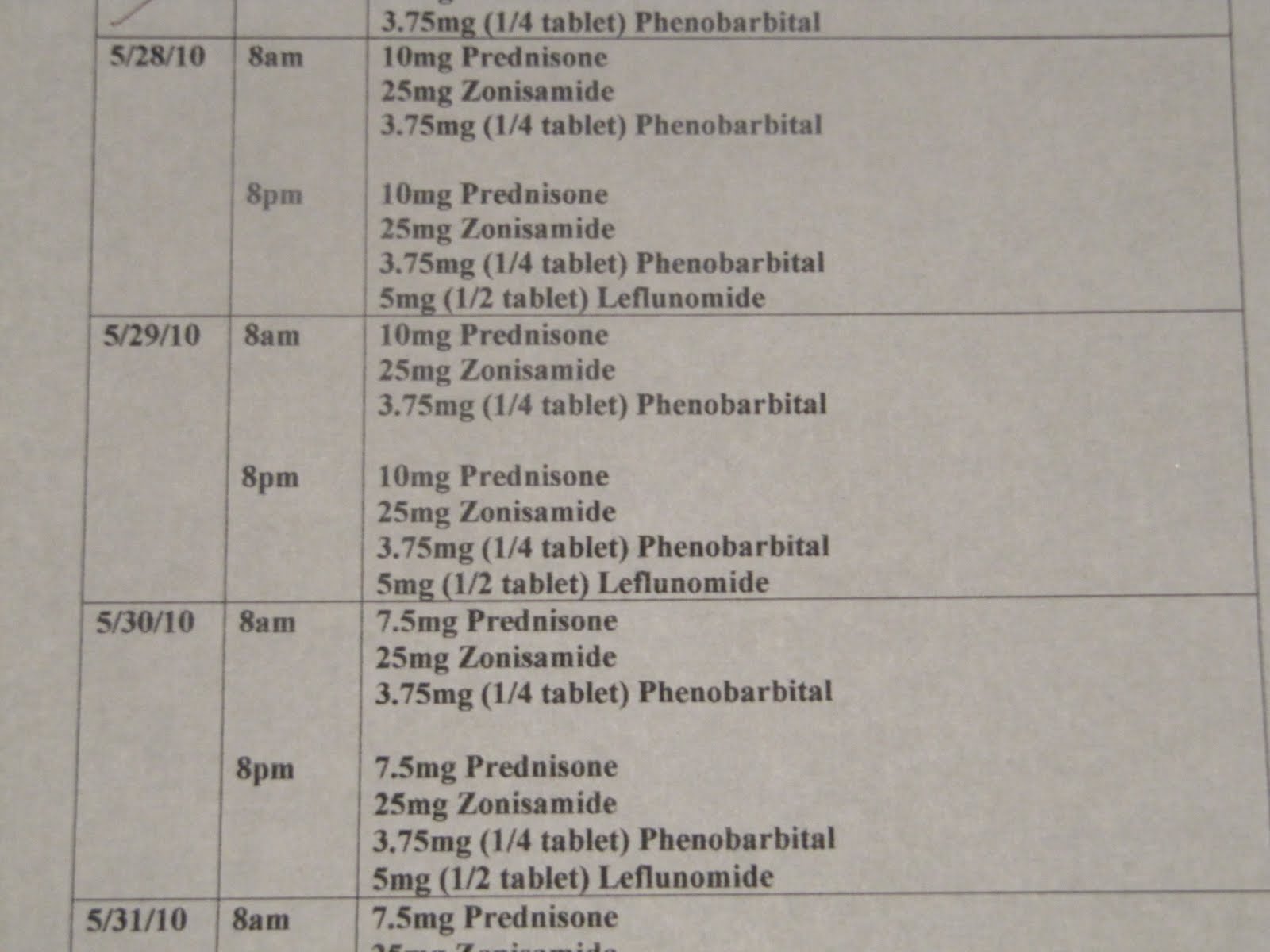
It took me at least an hour to put his entire medication schedule together. With all the medication changes - whether adding or discontinuing medication, decreasing or increasing medication doses, figuring out what blood work needs to be done when in conjunction with certain medication - it is overwhelming to say the least! But...I emailed my "medication schedule" to Dr. Sisson for his review - I had to make sure I had every med/dose/time correct. We're all set....however, it looks as if Coby will be on medication until at least mid-November.
Please continue to pray for Coby! Hopefully he responds VERY well to the medication and can be in FULL remission for his entire life!
Subscribe to:
Posts (Atom)
